Is Commercial EV Charging Right for Your Business?
Last reviewed: July 21, 2026
What Santa Rosa Businesses Should Consider Before Installing EV Chargers
Commercial EV charging can serve customers, employees, tenants or company vehicles, but the right installation depends on why the property needs charging in the first place.
A retail location where visitors stay for an hour has different requirements from an office where employees park all day. An apartment building, hotel and fleet facility each present another set of operating needs.
Before purchasing equipment, a Santa Rosa business should identify who will use the chargers, how long vehicles will remain parked and what the organization expects the installation to accomplish. Those answers help determine the number of charging ports, charging speed, payment structure and electrical infrastructure the property needs.
Start With the Business Objective
A charger should support a defined business or operational goal. Possible objectives include:
- Providing an amenity for customers
- Supporting employees who drive electric vehicles
- Attracting or retaining commercial tenants
- Charging company or fleet vehicles
- Preparing a multifamily property for resident demand
- Supporting sustainability commitments
- Generating charging revenue
- Meeting applicable development or building requirements
These goals are not interchangeable.
A business that wants to offer complimentary customer charging may prioritize visibility and ease of use. A property manager may need access controls and individual usage reporting. A fleet operator may care more about charging schedules, vehicle readiness and energy management than public access.
Defining the purpose first helps prevent buying equipment with unnecessary features—or installing a system that cannot support the intended users.
Consider How Long Vehicles Remain Parked
Vehicle dwell time is one of the most important factors in charger selection.
Level 2 charging is often well suited to locations where vehicles remain parked for one or more hours, including:
- Offices
- Hotels
- Multifamily properties
- Medical facilities
- Restaurants
- Wineries
- Shopping areas
- Public parking facilities
- Fleet yards where vehicles remain overnight
A vehicle does not always need to receive a full charge during its visit. At a workplace, several hours of Level 2 charging may replace an employee’s commute. At a retail property, a shorter session may add useful range while the customer is inside.
DC fast charging serves a different purpose. It can add substantial range during a shorter stop, but the equipment and supporting electrical infrastructure are considerably more complex. It may be appropriate where drivers specifically need rapid charging and the property can support the required power, utility coordination and investment.
Installing faster equipment than the site’s use case requires can increase project and operating costs without improving the customer experience.
Learn more about our approach to commercial EV charging solutions.
Estimate Realistic Demand
A business does not necessarily need to electrify every parking space during the first phase. It should, however, consider both current demand and reasonable future growth.
Useful questions include:
- How many employees, customers, tenants or fleet drivers currently use EVs?
- How often have people requested charging?
- How long do vehicles normally remain on the property?
- Will charging be available to the public?
- Could multiple vehicles need to charge simultaneously?
- Is future expansion likely?
- Can conduit or electrical capacity be planned now for later chargers?
A phased installation may begin with a limited number of active ports while preparing pathways or electrical infrastructure for future expansion. This can be more practical than installing every anticipated charger immediately or rebuilding the same area when demand grows.
Usage should be reviewed after installation. Actual charging-session data can help the business decide when additional ports are justified.
Evaluate the Property’s Electrical Capacity
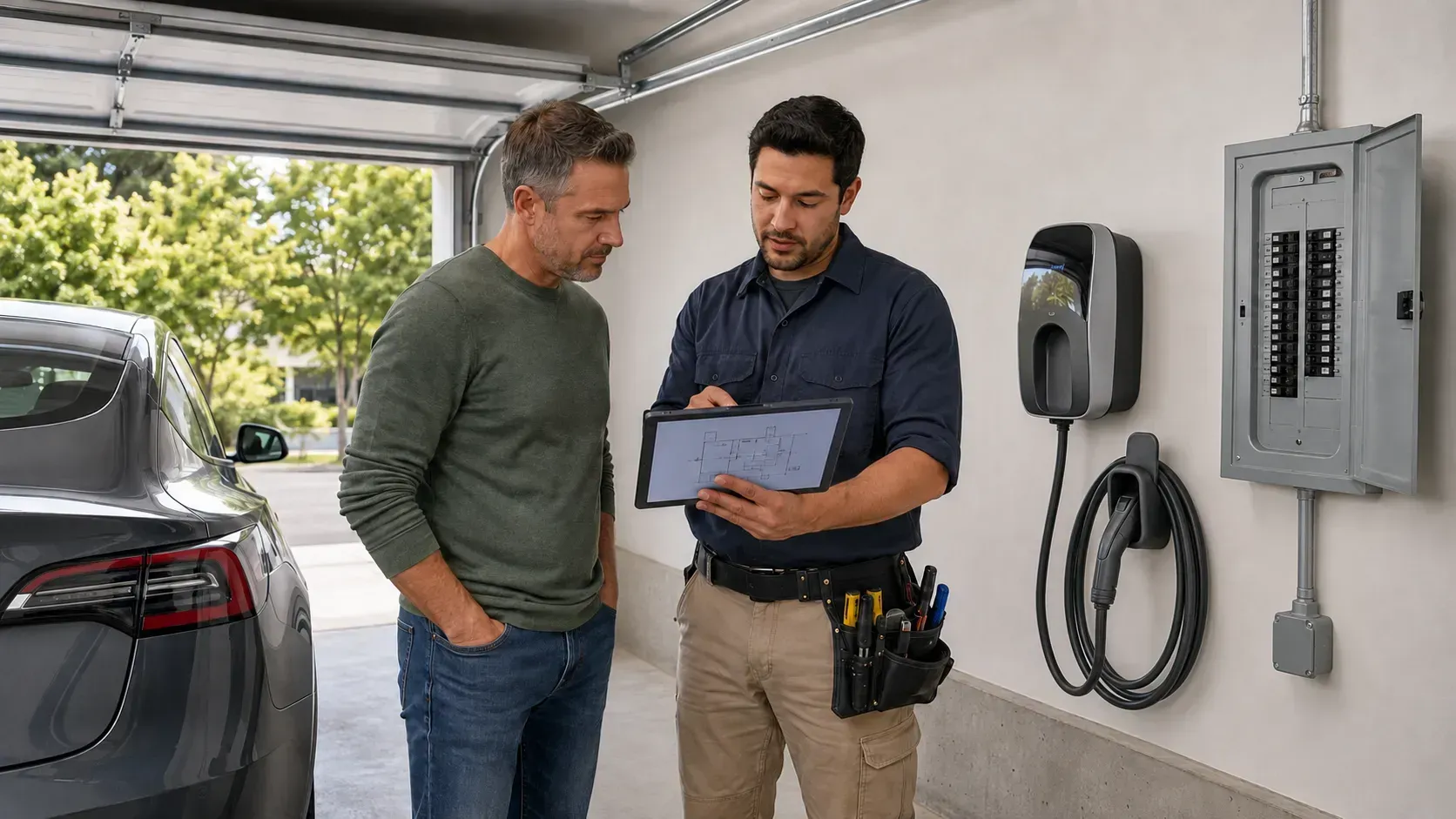
Commercial chargers can add substantial demand to a building’s electrical system. A site assessment should consider the available service, switchgear, panels, transformers and other building loads.
The assessment may include:
- Existing electrical-service capacity
- Available breaker and panel space
- Present and future building demand
- Charger quantity and output
- Distance to the parking area
- Conduit and conductor routes
- Trenching or pavement work
- Utility equipment and transformer capacity
- Future expansion plans
An available breaker position does not confirm that the property has enough capacity to operate several chargers simultaneously.
Some projects can use power-management equipment to distribute available capacity among multiple charging ports. Rather than allowing every charger to operate at maximum output at the same time, the system can adjust charging according to total site demand or established priorities.
This approach may reduce peak demand and help a property serve more vehicles with the available electrical infrastructure.
Our guide to electrical capacity for EV charging explains the underlying principles, although a commercial assessment will generally be more involved than a residential evaluation.
Networked or Non-Networked Chargers?
Non-networked equipment provides charging without cloud-based monitoring, access control or payment processing. It may work for a small private fleet or a business offering unrestricted complimentary charging.
Networked equipment can add features such as:
- User authentication
- Payment processing
- Session tracking
- Energy-use reports
- Remote status monitoring
- Pricing schedules
- Driver notifications
- Access restrictions
- Load management
- Fault alerts
These capabilities can be valuable, but they may also introduce activation charges, transaction fees, software subscriptions and ongoing network costs.
Before choosing a network, understand:
- The initial equipment and activation cost
- Monthly or annual fees
- Payment-processing charges
- Contract duration
- Cellular or Wi-Fi requirements
- Data ownership and reporting
- Remote-support availability
- What happens if the network service ends
- Whether the charger can operate without an active subscription
A charger should not be selected solely for its hardware price. The business needs to understand the total cost of operating the system over time.
See our guide to smart charging and energy management.
Free Charging, Paid Charging or Controlled Access?
The appropriate pricing model depends on the business objective.
Complimentary charging may be a useful customer or employee amenity. However, unrestricted free charging can lead to vehicles remaining connected longer than necessary or people using the property only for electricity.
Paid charging can offset electricity and operating costs, but it introduces payment processing, pricing decisions, customer-service responsibilities and potentially more complex equipment.
Other approaches include:
- Free charging for a limited time
- Employee-only access
- Tenant accounts
- Validated customer charging
- Different prices at different times
- Idle fees after charging is complete
- Fleet-only access
- A combination of public and restricted ports
The business should decide who is authorized to charge, how long vehicles may remain and how pricing or time limits will be communicated.
Parking Layout and Cable Management Matter
Commercial charging equipment must work within the physical parking environment.
Pedestals, bollards and cables should be positioned so they do not interfere with vehicle movement or regular pedestrian routes. Charging cables should reach vehicle ports without being stretched, driven over or left across traffic areas.
The site plan should consider:
- Parking-space dimensions
- Vehicle approach and orientation
- Charger protection from vehicle impact
- Cable length and storage
- Lighting and security
- Drainage and weather exposure
- Snow, landscaping or maintenance activities where applicable
- Pedestrian circulation
- Applicable accessibility requirements
Charge-port locations vary among vehicles. A layout that works perfectly for one model may be awkward for another. Equipment placement should accommodate a reasonable variety of vehicles without encouraging unsafe cable routing.
Accessibility requirements should be addressed during professional design and permitting. A generic parking-space layout should never be assumed to satisfy the requirements for a specific property.
Understand Electricity and Demand Costs
The cost of operating commercial charging includes more than the charger’s electricity consumption.
Depending on the utility rate and charging pattern, the business may need to consider:
- Energy charges
- Demand charges
- Time-of-use periods
- Network subscriptions
- Payment-processing fees
- Maintenance and repairs
- Cellular or internet service
- Customer support
- Insurance and administrative costs
Charging several vehicles at the same time can create a different utility-cost profile from charging the same vehicles in a managed sequence.
PG&E offers rate information for businesses operating EV charging, but the best rate depends on the property’s usage and metering arrangement. Current programs and requirements should be verified directly through PG&E’s EV rate-plan resources.
Historical building usage and projected charging demand can help the business evaluate available rate options before the system begins operating.
Plan for Maintenance and Reliability
Commercial chargers are used by more people and exposed to more wear than most residential equipment. Connectors may be dropped, cables may be mishandled and equipment may be exposed to weather or vehicle impact.
A maintenance plan should address:
- Routine visual inspections
- Cable and connector condition
- Cleaning and equipment care
- Bollards or impact protection
- Network and payment-system operation
- Error reporting
- Repair response times
- Replacement parts
- Warranty coverage
- Responsibility for driver support
A charger that is repeatedly unavailable can frustrate users and damage confidence in the service. Businesses should know who will monitor the equipment and how problems will be handled.
Permits and Utility Coordination
Commercial EV charging projects generally require more planning and documentation than a simple residential installation. The scope may involve electrical permits, site plans, accessibility review, trenching, utility coordination and final inspections.
Larger installations may also require engineering or design professionals. The City of Santa Rosa publishes construction-document requirements for EV charging stations, and project requirements can vary based on the site and proposed equipment.
Current information should be confirmed through the City of Santa Rosa Building Division.
Our overview of EV charger permits in Santa Rosa provides a useful starting point, but commercial projects should be evaluated individually.
Incentives Can Help, but Eligibility Must Be Verified
Utility, state, regional or federal programs may help offset portions of commercial charging costs. Eligibility can depend on the applicant, location, charger type, public availability, property use and program funding.
Programs may change, close or exhaust available funds. A project should not be financially dependent on an incentive until eligibility, application timing and current funding have been confirmed.
Some programs require approval before equipment is purchased or construction begins. Investigating incentives early can therefore be important.
Visit our guide to EV charger incentives and rebates and confirm current program terms directly with the administering organization.
When Commercial Charging May Not Be the Right Step Yet
Charging equipment may not be justified when there is little demonstrated demand, vehicles remain for only a few minutes, electrical upgrades are disproportionate to expected use or the business lacks a plan for operating and maintaining the system.
In that situation, the appropriate next step might be to:
- Survey employees or tenants
- Track customer requests
- Prepare conduit during other construction
- Reserve panel capacity
- Begin with fewer ports
- Reevaluate demand at a later date
Waiting can be more responsible than installing equipment that receives little use or cannot be properly supported.
Build the Charging Plan Before Buying Equipment
A commercial EV charging project should begin with the property and its users—not a particular charger model.
Before requesting estimates, the business should be able to describe:
- Who will use the chargers?
- How long will vehicles remain parked?
- How many vehicles may charge simultaneously?
- Will charging be free, paid or restricted?
- What electrical capacity is available?
- Who will operate and maintain the system?
- How might demand grow?
Once those questions are answered, charger type, quantity, output and networking requirements become much easier to define.
Contact us to discuss your Santa Rosa property, parking environment and charging goals. We can help identify the practical next steps for a commercial EV charging installation designed around the way your business operates.
Contact Us
Contact Us - Blog - Business Considerations